How We Helped a US Fintech Company Digitise Its Services
How We Helped a US Fintech Company Digitise Its Tax Services
From manual tax workflows to scalable, secure, automation-first operations.
Fintech products rarely fail because the idea is weak. They fail because the “last mile” is messy: documents arrive in inconsistent formats, the workflow depends on human judgment, compliance requirements add friction, and volume spikes are unpredictable.
This was the challenge we tackled with a US-based fintech operating in the personal and small-business tax space. Their core business depended on turning complex tax documentation into clean, accurate filings—fast, securely, and at scale.
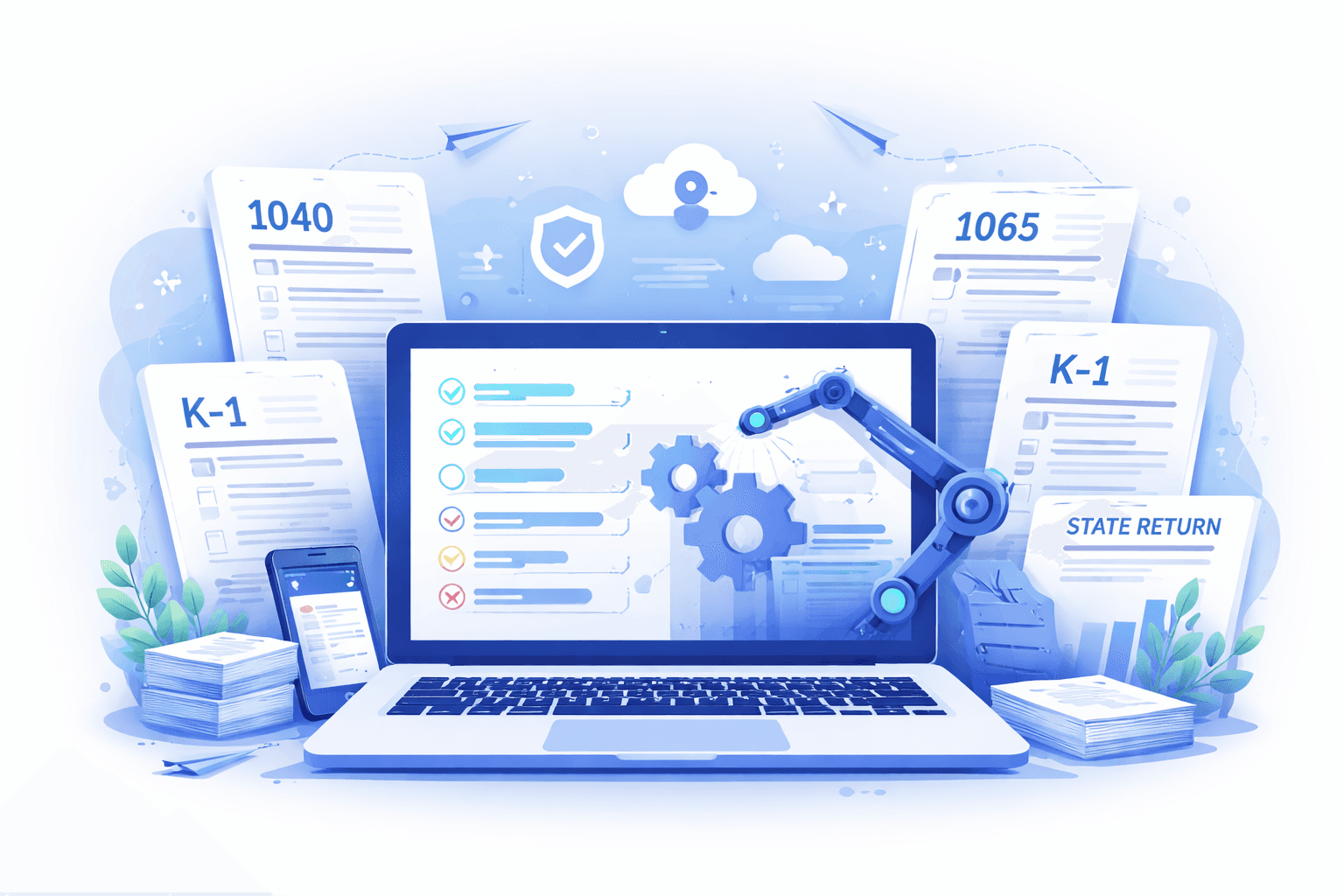
The mandate was clear: digitise and automate tax form processing across high-volume workflows like Form 1040, Form 1065, Schedule K-1, and state returns—without compromising accuracy, auditability, or customer trust.
This is how we approached it, what we built, and what other fintech founders can learn if they’re looking for a technology partner who understands regulated automation.
The problem: tax services are operationally complex by default
Tax processing looks simple from the outside: upload documents, fill forms, submit. In reality, it’s a document-heavy production line:
Inputs arrive as PDFs, scans, emails, spreadsheets, and portal uploads
Documents are incomplete, inconsistent, and full of edge cases
Multiple forms must reconcile with each other across entities and years
Accuracy is non-negotiable—errors create liability and churn
Compliance and security expectations are high (PII, access, retention)
Peak season creates extreme workload swings
The client had strong domain expertise and customer demand. The constraint was throughput: manual handling and fragmented tools limited scale, consistency, and speed.
They didn’t need “more engineers.” They needed an automation platform that made tax processing repeatable.
What “digitise” meant in practice (not a buzzword)
Digitising tax services is not just scanning PDFs. For a fintech business, it means:
Turning documents into structured, validated data
Building workflows that enforce process consistency
Making exception handling traceable and auditable
Integrating automation into existing operations (not disrupting them)
Achieving higher throughput while maintaining quality and compliance
In other words: a system that behaves like a disciplined operations team—at software speed.
Our approach: automate the workflow, then scale the throughput
We built the solution as a modular platform, designed to improve accuracy and speed over time.
1) Document ingestion built for real-world inputs
We implemented ingestion paths that reflect how tax documents actually arrive:
file uploads and portal submissions
email attachments and bulk drops
multi-document “packages” per customer/entity
versioning and replacement workflows (because documents change)
We normalized and classified files to ensure downstream steps could run consistently.
2) OCR + extraction for tax-specific structures
Tax forms are structured—but not always cleanly. We built an extraction pipeline that:
detects form types (1040, 1065, K-1, state returns, and common attachments)
extracts key fields with confidence scoring
validates totals and cross-field consistency
flags ambiguity and routes exceptions to human review
The key wasn’t “AI.” The key was reliability: deterministic checks, rules, and audit trails wrapped around intelligent extraction.
3) A human-in-the-loop review layer (where it matters)
In regulated workflows, the best automation is “assistive”—it accelerates humans rather than pretending humans are unnecessary.
We built a review experience that:
shows source evidence beside extracted values
supports quick approval/correction
captures reviewer actions for auditability
learns from patterns via rule tuning and model prompts/configuration
This was crucial for quality, training, and trust.
4) Workflow orchestration for seasonality and volume spikes
Tax season is not forgiving. We designed the system to handle:
queue-based processing and prioritization
workload routing to teams
SLA visibility and operational dashboards
retry logic and failure isolation
cost-aware scaling (so peak season doesn’t create runaway cloud spend)
5) Compliance-first engineering
Because the platform handled PII and sensitive financial information, we built with enterprise-grade expectations:
role-based access control and least privilege
encryption in transit and at rest
audit logging for critical events and user actions
environment separation and disciplined release practices
data retention controls and secure deletion patterns where applicable
Digitisation that creates new risk is not progress. This project was designed to reduce risk while increasing throughput.
Milestone timeline (how we shipped without slowing the business)
Phase 1 — Discovery and workflow mapping
We mapped the real tax processing lifecycle:
intake → classify → extract → validate → review → export/submit → retain
We defined what “done” means for each form type, and where exceptions belong.
Phase 2 — MVP automation for the highest-volume forms
We launched automation around the highest-impact workflows:
Form 1040 processing assistance
business returns (including 1065)
K-1 extraction and reconciliation support
core state return workflows
Phase 3 — Quality hardening and exception operations
We strengthened:
validation rules and reconciliation checks
human review UX and evidence linking
audit trails and operational visibility
Phase 4 — Scale and continuous improvement
We expanded coverage across more edge cases and document variations, while improving throughput and reliability via:
model and prompt iteration
rules tuning
workflow optimizations
performance and cost controls
The stack (built for fintech-grade reliability)
We used a modern, scalable stack suited to regulated automation:
TypeScript / JavaScript
React (frontend)
Node.js (backend)
AWS (secure, scalable deployment patterns)
PostgreSQL (structured data + workflow state)
LLM-assisted components where they improved extraction, classification, and exception handling
The point wasn’t the stack itself—it was the outcomes it enabled: maintainability, observability, auditability, and controlled evolution.
Outcomes that matter in fintech tax services
We avoid publishing generic “X% faster” claims without a shared baseline. But the business outcomes were clear and measurable in operational terms:
faster end-to-end processing cycles for core forms (1040, 1065, K-1, state returns)
reduced manual data entry through OCR + structured extraction
fewer errors through validation and reconciliation checks
better visibility: queues, workload, SLA risk, and exception reasons
stronger controls: auditable review actions and traceable evidence
a platform that could scale during peak season without breaking operations
For fintech, digitisation becomes real when it improves two things at once:
unit economics (lower cost-to-serve) and trust (quality and compliance).
What founders should take away
If you operate in a document-heavy, regulated domain—tax, insurance, lending, compliance—digitisation succeeds when you treat it as a workflow problem, not an OCR problem.
A strong build partner will:
understand the operational lifecycle (not just the UI)
design for exceptions and governance from day one
ship MVP fast without creating compliance debt
build systems that scale through peak volume and scrutiny
That is the difference between a demo and a production platform.
If you’re digitising a regulated service
If you’re building fintech automation around document-heavy workflows—especially where accuracy, auditability, and security are non-negotiable—we can help you design the workflow, build the automation layer, and scale it safely.
Contact

